
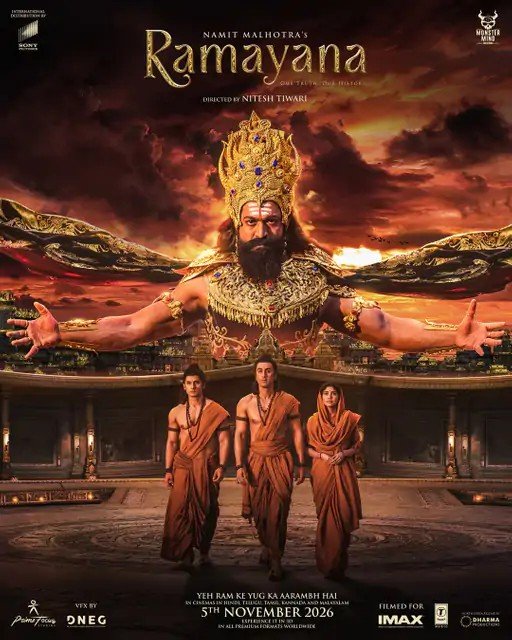
The film Rāmāyaṇa begins with the story of Rāvaṇa. It traces his rise and his determination to uplift his Asura clan, which is depicted as living in a terrible state in Rasātala. Rāvaṇa’s penance is beautifully portrayed, followed by his acquisition of the boon of immortality from Lord Brahmā. His conflict with the gods is contextualised through the deplorable condition of the Asuras, making his struggle appear justified. His devotion, austerities and valour captivate the audience right from the beginning. The Śivatāṇḍava Stotra is effectively employed to portray his victories over the three worlds. The narrative of Rāvaṇa is so compelling that the subsequent story of Rāma appears somewhat overshadowed.
The frame narrative is a significant element of any literary narrative, as it establishes the context within which the story unfolds. In Vālmīki Rāmāyaṇa, the narrative begins with the dialogue between Vālmīki and Nārada, in which the latter describes the various virtues of Rāma as Maryādā Puruṣottama. In the film, however, the framing narrative centres on Rāvaṇa’s rise and his mission to rescue his own clan. This fundamental shift in the narrative framework has a considerable impact on the audience’s perception of the epic.
Rāvaṇa is not portrayed as a womaniser, as he is depicted in the Uttarakāṇḍa of Vālmīki Rāmāyaṇa. Nor is he shown receiving curses from women such as Vedavatī and Rambhā. His decision to abduct Sītā is motivated not by an infatuation with her beauty but by his desire to avenge the humiliation of Śūrpaṇakhā. More significantly, the film suggests that he intends to use this opportunity to confront and ultimately kill Viṣṇu, whom he recognises in Rāma. Thus, the abduction is presented not merely as an act of revenge but also as part of his larger goal to challenge Viṣṇu.
His battles with Kubera’s army, Viṣṇu and other gods, and finally with Jaṭāyu, are depicted with remarkable vigour and power. In contrast, Rāma’s encounters with Tāṭakā, Subāhu, Khara, Dūṣaṇa and others rely more heavily on miraculous mantra-power than on physical valour.
The depiction of Daśagrīva Rāvaṇa is particularly noteworthy for its symbolism. Whenever he deliberates over a matter, he is advised by ten different manifestations of his own self, representing diverse personalities such as the mature Rāvaṇa, the diplomat and the sensualist (vilāsī), etc. These personalities subsequently merge into his ten heads. This is an imaginative visual representation of his ability to consider a situation from ten different perspectives.
At several points in the film, Rāvaṇa is depicted standing amidst revolving planets, symbolically suggesting his conquest over the celestial bodies and his dominion over the three worlds. This visual imagery reinforces his cosmic ambition, supremacy and the magnitude of his power. His knowledge of the Vedas is also highlighted in the episode of Sītāharaṇa. When Sītā refuses to cross the prescribed boundary, she asks Rāvaṇa to recite the mantras from Ṛgveda 10.121, which he does. Such details contribute to the portrayal of Rāvaṇa as a learned and multifaceted personality.
An important concept in narrative studies is focalisation, which concerns the perspective through which a narrative is presented and the character or events upon which the narrative focus rests. In this film, the narrative is predominantly focalised through Rāvaṇa. His story receives greater detail, elaboration and logical development. Several episodes associated with Rāma are comparatively brief, perhaps because they are already familiar to the audience.
Rāma’s story is not compromised, but it does not acquire the same narrative intensity as Rāvaṇa’s. The casting of Ranbir Kapoor as Rāma also contributes to this response. The sublime and noble character of Rāma presents a particular challenge in this casting, given the audience’s preconceived associations with the actor. As Abhinavagupta (commentator of Nāṭyaśāstra) observes, the experience of Rasa is vīta–vighna-pratīti (unobstructed aesthetic experience). The spectator’s response should be free from impediments. One such impediment may arise from preconceived notions that interfere with the aesthetic experience. In this context, it becomes somewhat difficult to disassociate Ranbir Kapoor’s familiar screen persona from the character of Rāma. Sītā’s purity and sublimity are portrayed with considerable sensitivity. However, despite her noble and elevated character, Sītā, as Sai Pallavi does, does not quite outshine Maṇḍodarī, Śūrpaṇakhā or Kaikasī in the film.
Some Noteworthy Narrative Improvisations
The Story of Śūrpaṇakhā: The background story of Śūrpaṇakhā, found in the Uttarakāṇḍa of Vālmīki’s Rāmāyaṇa and in later Rāmāyaṇa traditions, is associated with the death of her husband, Vidyujjivha, who was either accidentally killed by Rāvaṇa during a war or her son Sāmba, whose death was attributed to Lakṣmaṇa, who unknowingly killed him. In these versions, Śūrpaṇakhā incites Rāvaṇa to avenge the injustice she has suffered. She is thus portrayed as a woman carrying deep personal grief.
The film offers a different interpretation. Here, Śūrpaṇakhā’s husband, Vidyujjivha, becomes arrogant and challenges Rāvaṇa. Rāvaṇa kills him openly before the entire royal court and the people of Laṅkā. This provides a different context for the relationship between Rāvaṇa and Śūrpaṇakhā.
Another significant departure from Vālmīki’s narrative concerns her encounter with Rāma. Unlike the traditional account, Śūrpaṇakhā first sees Rāma in the presence of Lakṣmaṇa and Sītā. Although aware that Rāma is married, she still desires to marry him and subsequently approaches him when he is alone. When Rāma refuses her advances, she assumes the form of Sītā and enters Rāma’s hut in the presence of Lakṣmaṇa. When the real Sītā arrives, Lakṣmaṇa discovers the deception. He punishes Śūrpaṇakhā, not by cutting off her nose, but by injuring her nose and face with his sword.
Significantly, both Rāma and Sītā disapprove of such treatment of a woman. This creative intervention addresses several questions traditionally raised about the episode: Why does Rāma direct Śūrpaṇakhā towards Lakṣmaṇa? Why does Lakṣmaṇa mutilate her? Later Rāmāyaṇa traditions further elaborate the episode by describing the cutting off of her nose, lips and breasts, thereby associating the punishment with the destruction of her feminine identity. The film’s interpretation offers an alternative perspective on this much-debated episode.
Sītā enchanted by the Magical Spell of Mārīca: Traditional interpretations have often raised the question of how Sītā, endowed with such exceptional virtues, could be attracted by a golden deer. The film provides an interesting explanation by showing that Mārīca allures her even before assuming the form of a deer. Sītā is thus portrayed as being captivated by Mārīca through his magical influence, rather than being distracted merely by the deer’s external beauty. This interpretation seeks to preserve her character from any possible blemish.
The Battle Between Rāvaṇa and Jaṭāyu: The battle between Rāvaṇa and Jaṭāyu is undoubtedly one of the most spectacular sequences in the film. Rāvaṇa, carrying Sītā in the magnificent Puṣpaka Vimāna, engages in a fierce encounter with Jaṭāyu’s army. The scale, visual treatment and intensity of this sequence make it one of the film’s most magnificient moments.
Women as Warriors: Sītā and Kaikasī: Another noteworthy aspect of the film is its portrayal of women as warriors. Kaikasī, Rāvaṇa’s mother, is depicted as a formidable warrior fighting fiercely on the side of the Asuras. In fact, the film opens with a battle between the Asuras and the gods, in which Kaikasī is shown actively participating in the warfare. In fact, she is the one who entices Rāvaṇa to act for the upliftment of the Asura clan. This portrayal immediately establishes the presence of strong female characters and adds a feminist dimension to the narrative.
Similarly, Sītā is presented in a different light. When the army of Khara and Dūṣaṇa advances, she is prepared with weapons and ready to fight. This brings out another dimension of her personality, presenting her not merely as a passive figure in the unfolding conflict but as a woman capable of defending herself.
Through the characters of Kaikasī and Sītā, the film portrays them as courageous, assertive and capable of participating in warfare. This is a significant departure from representations that predominantly position women as passive figures in the narrative.
The film employs symbolism effectively in certain crucial episodes. After Sītā crosses the Lakṣmaṇarekhā, she is directly shown inside the Puṣpaka Vimāna. The actual act of her abduction by Rāvaṇa is not explicitly depicted. Instead, it is symbolically suggested through the fruits and the red flower she was wearing, which are shown fallen on the ground. This visual treatment leaves the act of abduction to the viewer’s imagination. Interestingly, later Rāmāyaṇa traditions introduce the motif of Chāyā Sītā, which offers another interpretative dimension to the episode.
Ultimately, the film offers an interesting reinterpretation of the Rāmāyaṇa, particularly through its narrative emphasis on Rāvaṇa. By shifting the focalisation, modifying familiar episodes and introducing symbolic visual elements, it invites the audience to reconsider characters and events that have been narrated and interpreted for centuries.
Overall, the film presents the Rāmāyaṇa predominantly as a narrative of war and conflict, rather than giving emphasis to its other philosophical, ethical, devotional and emotional dimensions. Its narrative energy is concentrated on the rise of Rāvaṇa, his ambitions, his battles and his personal motivations. Consequently, the film raises an interesting question: Is this Rāmāyaṇa, or is it, in a certain sense, a Rāvaṇāyana?